 Fitrah
Research paused · seeking collaborators
Findings
What holds, what doesn’t, and what we learned
Every result from Lab 0 and the experiments around it, including the negative ones. All of it is bounded: proven within stated models and limits, not in general. Lab codes are explained in the glossary. Updated 2 Nov 2026
Lab 0, stage by stage
From hostile requests to hostile code
| Stage | What was tested | Result | Status |
|---|---|---|---|
| Stage 1 | 26 hand-written attack scenarios from a scripted attackerA0. No rules vs rules in the prompt vs Fitrah enforcement. | Without enforcement: 10 invalid agents created, 4 inherited-rule changes and 3 blocked-action bypasses. With enforcement: 0, 0, 0, and none of the 6 legitimate cases blocked. Reruns were byte-identical and an independent verifier agreed. | Complete |
| Stage 1B | Deep lineages, generated histories, fault injection, bounded exhaustive search. Reproduced on GitHub-hosted runners. | No rule was ever broken across 100 generations, 2,000 generated histories (100,000 state changes) and every one of 6,742 reachable states (459,386 state changes). It also found and fixed bugs in the verifier. | Complete |
| Stage 1B limit | Can replayed, signed evidence prove what happened? | No. It proves the record is consistent, not that it’s true. A compromised runtime that lies consistently passes the checkTC-26. | Fundamental limit |
| Stage 2 environment | Disposable, disconnected Hyper-V Linux VM: separate non-root identities, protected filesystem, no network, descendant containment. | All nine prerequisites pass. In the containment testS65, child processes that fork or detach escape ordinary process-group termination; a Linux cgroup boundary stopped every one. | Ready |
| Stage 2 integration | Synthetic filesystem pilot, then a guarded resource-backed run. | The pilot passed, and exposed a bug where evidence and state could fall out of stepTC-27, since fixed. The first full run failed: the agent was authorised but didn’t start. Cleanup was confirmed, nothing ran, and the failed run is kept as evidence. | Incomplete |
Experiments E1–E9
Fair fights against the strongest baselines
Bounded models, run without a VM, designed to find out whether Fitrah adds anything beyond modern authorisation systems. Several answers were “no”, which is exactly why they matter.
| Experiment | Question | Finding | Verdict |
|---|---|---|---|
| Simple vs strong delegationE1 · E2 | Does Fitrah reject agents that delegation accepts? | Against simple delegation, yes: 60 of 64 states. Give the delegation system the same trusted facts and the difference largely disappears. | No expressiveness edge |
| Agent start-upE3 | What can go wrong while an agent is being created? | Retrying a launch with an uncertain outcome creates two live agents for one birth. Forbidding retry while uncertain removes it. | Fail-closed rule |
| Catching a lying runtimeE4 | What catches a runtime that signs a false history? | Its own signed log catches nothing. An external birth witness catches false or hidden births; resource receipts catch false writes; instance measurement catches false instances. | Needs independent witnesses |
| Groups of agentsE5 | Do per-agent rules make a group of agents safe? | No. A reads a secret and sends it to B; B writes it publicly. Every step is individually allowed. | Collusion counterexample |
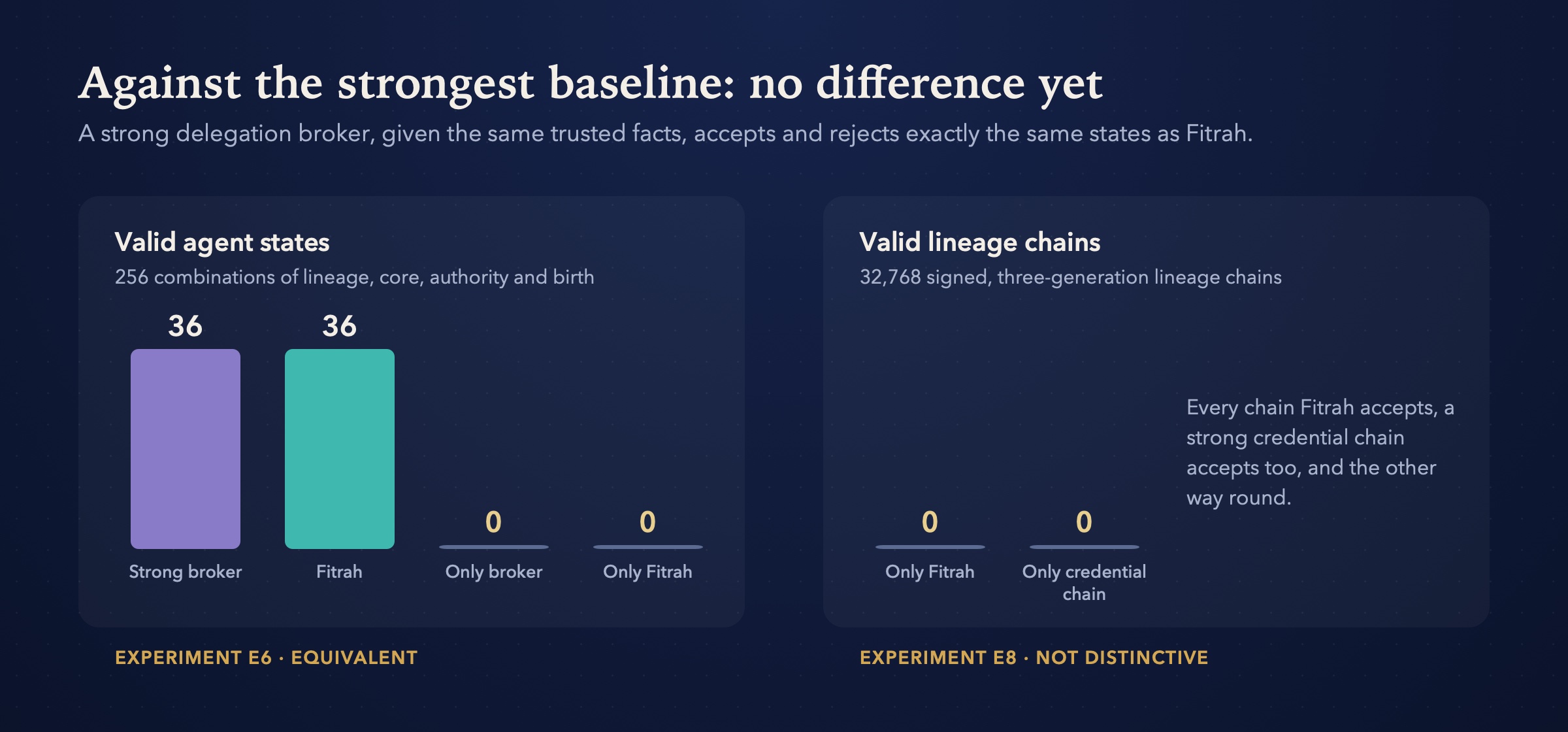
| Strongest baselineE6 | A strong delegation broker, given the same trusted registration steps, vs Fitrah | 256 states examined: 36 valid in each, 0 unique to either. | Equivalent |
| Shared budgetsE7 | Should siblings share one authority budget? | Designed to test whether aggregate budgets differ from a stateful reservation broker. | Designed |
| Lineage evidenceE8 | Is a verifiable family tree of agents distinctive? | Across 32,768 lineage chains, a strong credential chain matches Fitrah exactly. | Not distinctive |
| Binding authorityE9 | Can authority leak between an agent’s creation and its link to a running process? | Decoupled lifecycle: yes, a crash leaves a process holding authority without a committed binding. Gated lifecycle: no tested crash did. | Gate authority on binding |
Lessons learned
Eleven things building Fitrah taught us
Putting the rules in the model’s context made no measurable difference. Enforcement has to sit outside the model.
Stage 1If the guarantees only hold while the model cooperates, they aren’t guarantees. Fitrah’s rules are enforced with no AI model present.
Lab 0 designFitrah beats “no enforcement” easily. Against a strong broker with the same trusted facts, it ties. Only the second comparison counts.
E1 · E2 · E6 · E8Catching a lying runtime needs independent witnesses: birth witnesses, resource receipts, instance measurements.
TC-26 · E4Stress-testing the runtime also found and fixed defects in the verifier that checks it.
Stage 1BProcesses that fork or detach escape ordinary termination. A Linux cgroup boundary caught every one.
Stage 2 · S65Retrying can give one birth two live agents. Fail closed while the outcome is unknown.
E3Grant protected authority only after birth, core, evidence and instance are committed together, atomically.
E9 · TC-27Population safety isn’t the sum of per-agent rules. It needs information-flow or group-level constraints.
E5The failed run, the verifier bugs and the negative comparisons are all preserved. A record that only keeps wins can’t be trusted.
Research disciplineA sister project, Research Forge, was stopped at a NO-GO gate: no validated need, and strong prior art. Stopping early is a result.
Research ForgeGlossary
The lab codes, in plain words
- Stage 1, 1B, 2
- The three phases of Lab 0: scripted attacks, deep stress-testing, then hostile code in a disposable virtual machine.
- E1–E9
- Small, bounded experiments that compare Fitrah with the strongest existing alternatives.
- A0
- The weakest attacker class: a script sending hostile requests, not running hostile code.
- TC-26, TC-27
- Recorded research findings: TC-26 is the “signed logs prove consistency, not truth” limit; TC-27 is the evidence/state bug found and fixed.
- S65
- The containment test that tries every way a child process can escape and checks that none survive.
- Delegation broker
- An existing kind of system that hands out narrowed permissions and checks them (for example macaroons, Biscuit, UCAN).
- Bounded
- Proven for every case up to a stated size or depth, not for all possible cases.
- Open question (OQ)
- A research question Fitrah can’t answer yet. Each has a public issue.
How decisions are made
Seven gates before anything gets built
Every candidate direction, in Fitrah and its sister projects, has to pass these in order. Research Forge, a proposed research-provenance platform, failed the first three and was closed with its negative findings preserved.
- Need: a specific, recurring, unmet problem with identified users
- Prior art: a capability beyond the strongest existing baselines
- Discriminating claim: a measurable failure of the best composite comparator
- Feasibility: a plausible solution with bounded complexity
- Outcome: independent comparative improvement
- Adoption: sustainable open-source value
- Product fit: real willingness to adopt
Go deeper