 Fitrah
Research paused · seeking collaborators
Research
The hypothesis, the architecture, and what’s next
What Fitrah set out to prove, how the problem breaks into layers, and the directions that look most promising now. Updated 2 Nov 2026
The hypothesis
What makes a child agent valid
- 01Its mandatory rules are inherited unchanged from its lineage.
- 02The authority it can use never exceeds what its parent may hand down.
- 03The authority it can pass on never grows from one generation to the next.
- 04A sensitive action runs only when both its authority and its inherited rules allow it.
- 05All of this stays enforceable with no AI model present.
Formally: core(child) = core(root), C(child) ⊆ Dg(parent) and Dg(child) ⊆ C(child), where C is the authority an agent can use and Dg the authority it may delegate. See the invariants.
Architecture
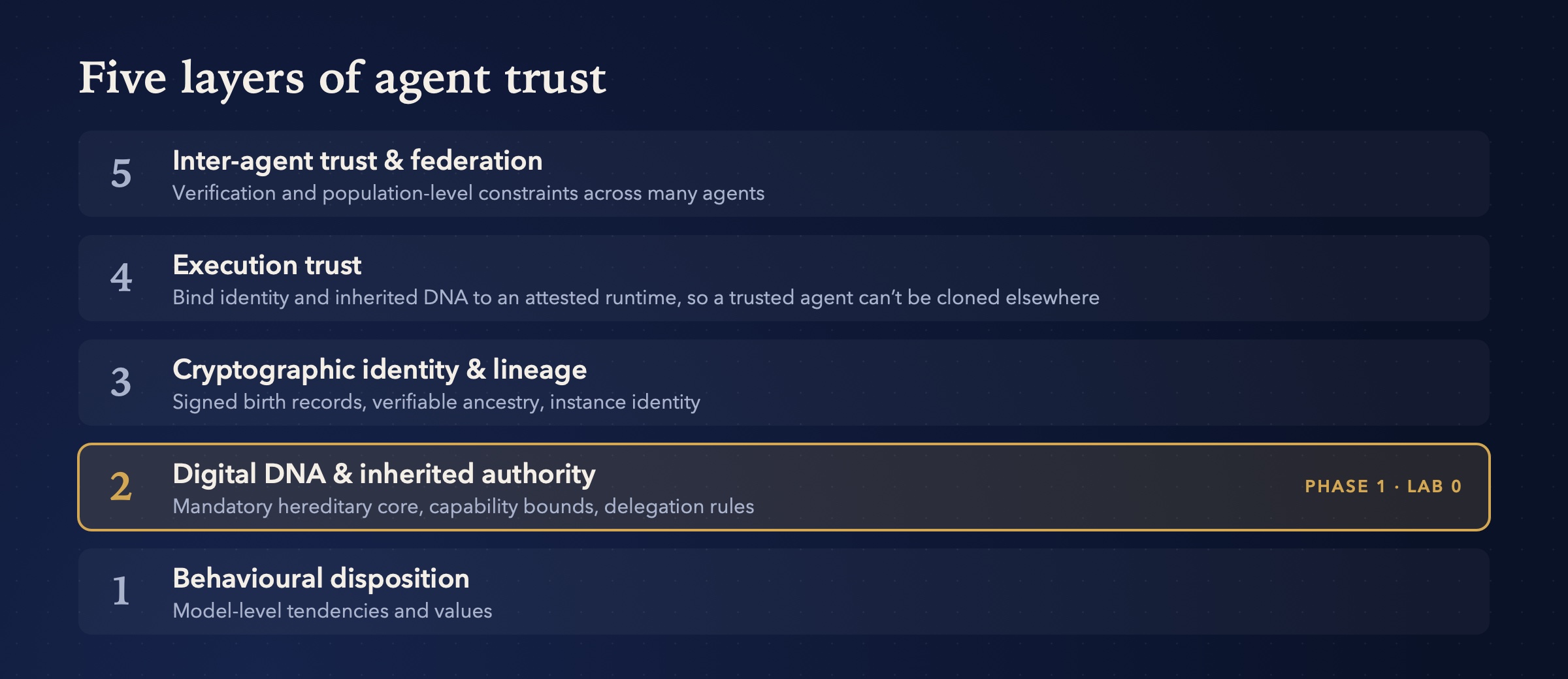
Five layers of agent trust, one at a time
Phase 1 focused only on Layer 2: inherited authority has to hold before identity, attestation or federation can mean anything.
Where it could go next
Three candidate directions
From the frontier gap assessment, ranked by scientific value and by how much strong prior art already covers them. None is approved yet: each needs a fair comparison against the strongest baseline first.
Lifecycle assurance across runtimes
A portable, verifiable chain from authorised birth to attested instance to real-world effect and audit, compared with standards-based deployments that aren’t composed.
Group-level constraints
Can a policy checked at the point of real-world effect reject harmful group behaviour that per-agent policies accept, without blocking legitimate work?
Inherited judgement
Does a verified lineage improve refusal and escalation beyond an equal persistent-policy baseline? The causal case is currently weak.
Open questions